Ask any Swede what fika means and you’ll probably get a shrug, followed by “it’s just… fika.” That’s the tricky part about explaining this word to newcomers: it’s not really about the coffee, and it’s not really about the cinnamon bun either, even though both usually show up. Fika is a pause, and a deliberate one at that.
What happens during fika?
At its simplest, fika is coffee (or tea) with something sweet, shared with someone else. It can happen at 10 a.m. in an office kitchen, at a kitchen table with a grandparent, or on a bench in a park with a thermos. What makes it fika and not just “having a coffee” is the intention behind it: you stop what you’re doing, and for those fifteen or twenty minutes, that’s the whole activity. Not a work meeting with coffee on the side; the coffee and the conversation *are* the meeting.
Workplaces in Sweden often treat fika as a fixed part of the day, sometimes twice: a morning fika around 9 or 10, and an afternoon one around 3. Skipping it isn’t rude, but joining it is usually seen as normal, even expected, especially when you’re new somewhere and trying to get to know colleagues.
en fika (noun): the coffee break itself
att fika(verb): to have a fika
Ska vi fika?: “Shall we fika?”, a completely normal thing to say to a friend or a new colleague
Kanelbulle, kladdkaka, and the rest
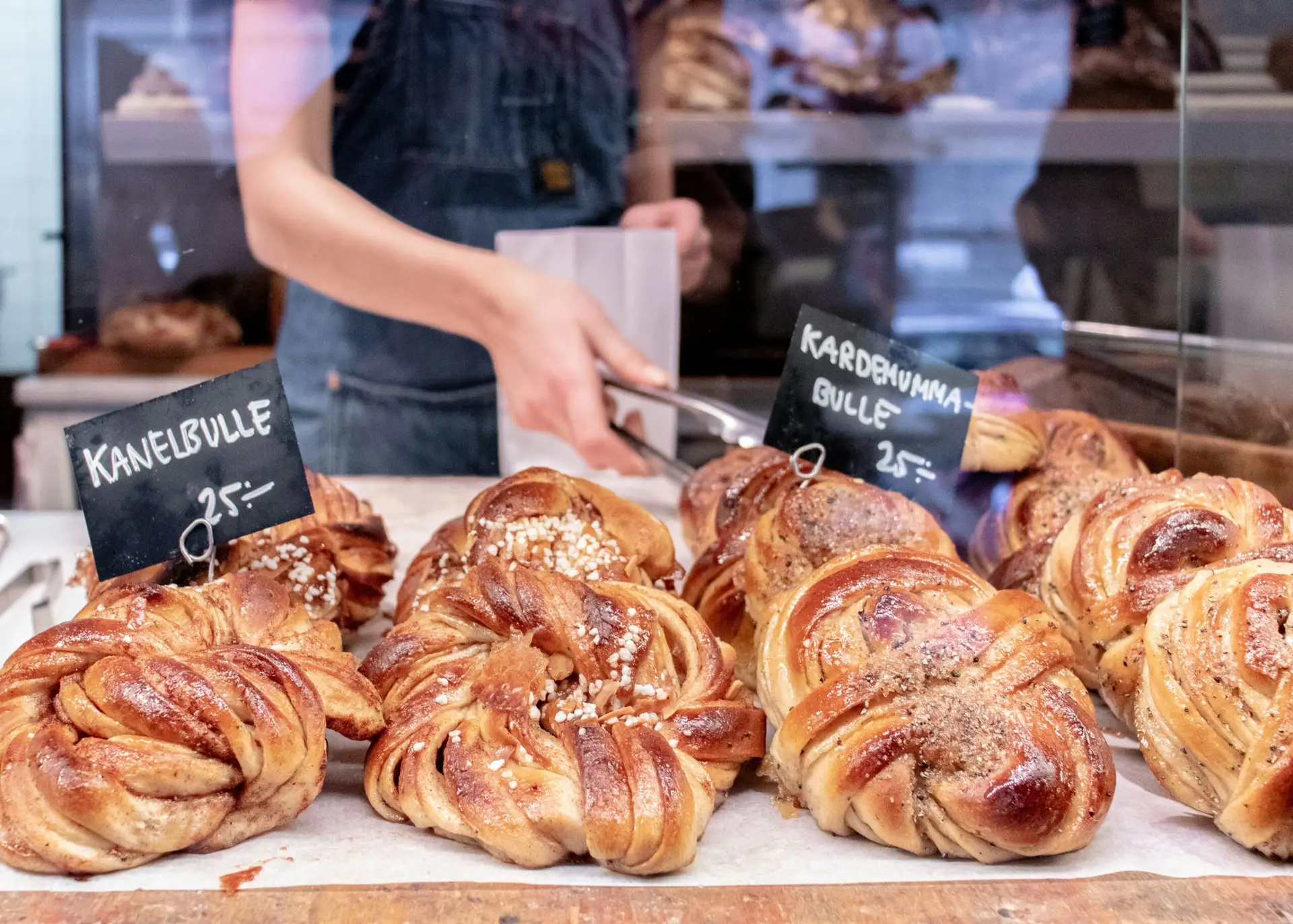
A fika without something to eat is unusual, though not against the rules. The most iconic pairing is the kanelbulle (cinnamon bun), especially around October 4th, which has been unofficially declared Cinnamon Bun Day (kanelbullens dag) in Sweden. Other regulars include kladdkaka (a dense, gooey chocolate cake) and simple butter cookies. None of it needs to be fancy. A fika at home with store bought biscuits counts just as much as one at a bakery.
Why doesn’t the concept quite translate?
English doesn’t really have a single word for this. “Coffee break” comes close but misses the social core of it, since fika is rarely done alone, and doing it alone, while not unheard of, changes its character. “Coffee date” overcorrects in the other direction and makes it sound more formal or romantic than it usually is. That gap is part of why the word has started showing up untranslated in English language articles about Swedish culture. There simply isn’t a clean equivalent.
If you want a working definition for your own vocabulary: fika is both a noun (en fika) and a verb (att fika), and it’s used constantly in everyday speech, not saved for special occasions.
If you’d like to learn more, we’d love to have you join our courses! Feel free to reach out anytime with questions at info@swedishready.com.
Våga prova!