If you ask a Swede which holiday matters most to them, a surprising number will say Midsummer (midsommar) before they say Christmas. It falls on the Friday between June 19th and 25th, close to the summer solstice, and for many Swedes it marks the real, emotional start of summer, the point where work slows down, cities empty out, and everyone heads to the countryside or the archipelago.
Flowers, poles, and a dance about frogs
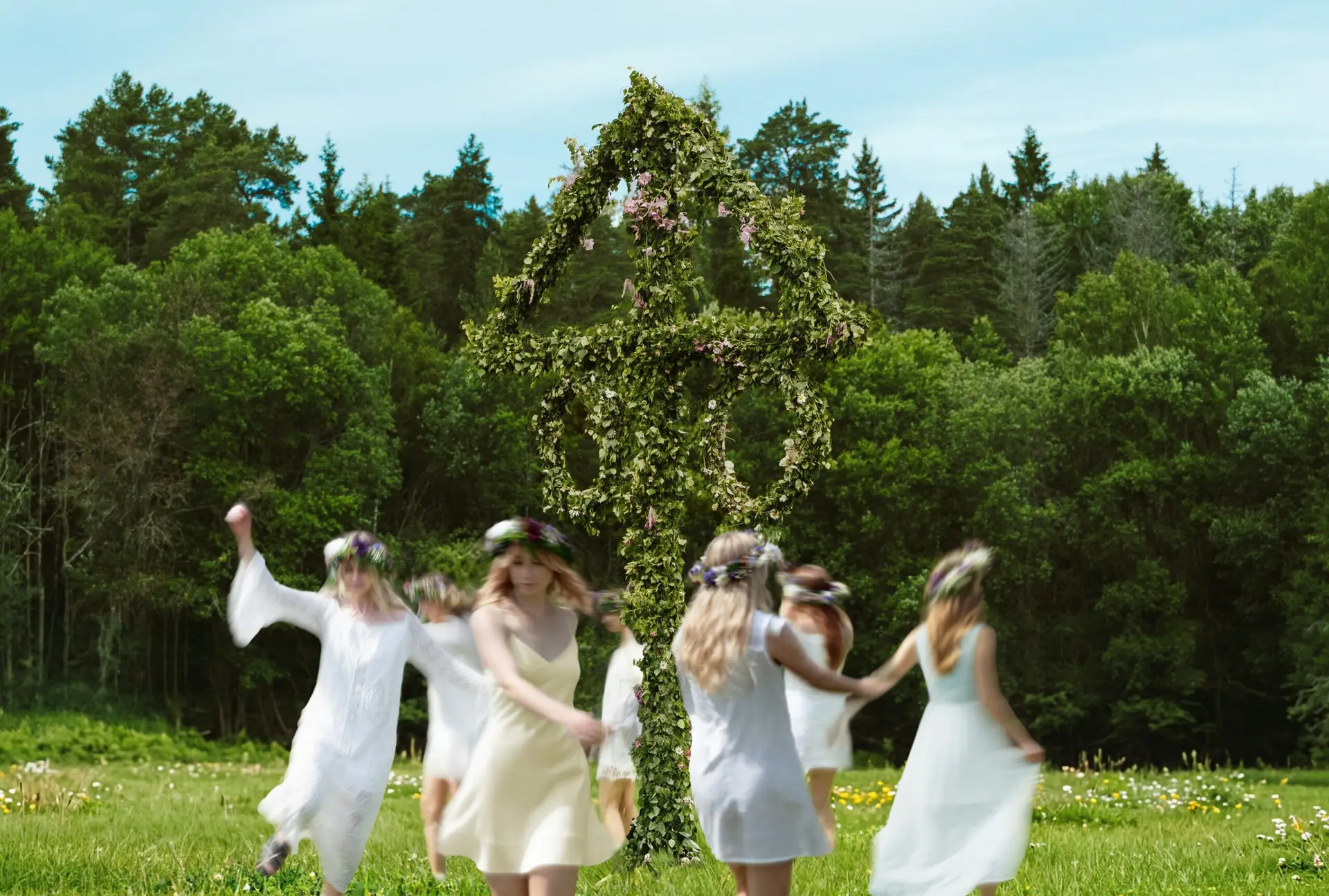
The most recognizable image of Swedish Midsummer is the midsommarstång (also called majstång), a tall pole decorated with leaves and flowers, raised in an open field. Around it, people, often in traditional dress, though plenty just wear regular summer clothes, join hands and dance to a handful of well known songs. The most famous of these is “Små grodorna” (“The Little Frogs”), which involves hopping around and imitating frogs. It looks, and is, a little silly. Nobody minds.
Flower crowns (midsommarkrans) are another central tradition, worn by children and adults alike. Making them is often a group activity earlier in the day, using wildflowers picked nearby. There’s an old belief that if an unmarried woman picks seven or nine different flowers in silence and places them under her pillow that night, she’ll dream of her future husband.
midsommarafton: Midsummer’s Eve, the main celebration day (a Friday)
midsommardagen: Midsummer’s Day itself, the Saturday
en krans: a wreath or crown, as in midsommarkrans, a flower crown
The Midsummer table
Food follows a fairly fixed script. Pickled herring (sill) in several varieties (mustard, dill, onion) is the centerpiece, usually eaten with boiled new potatoes, sour cream, and chives. It’s traditionally the first proper harvest of new potatoes each year, which is part of why the meal feels so tied to the season. Fresh strawberries, ideally Swedish grown and at their sweetest around this time of year, typically close out the meal, sometimes with cream, sometimes simply on their own.
Aquavit (a flavored spirit) often accompanies the herring course, along with short drinking songs (snapsvisor) sung before each shot, a tradition that tends to get livelier as the evening goes on.
Why it matters so much
Part of what makes Midsummer significant is geography. In much of Sweden, and especially further north, the sun barely sets around this time of year. That light, after a long, dark winter, carries real emotional weight. Midsummer isn’t only a festival, it’s a collective exhale. Offices, shops, and even some public transport schedules scale back for the day, and it’s common for Swedes living abroad to make a point of coming home for it, even when they skip other holidays.
For a language learner, Midsummer vocabulary is worth picking up early, since you’ll hear it used constantly in conversation and in the news each June. If you’d like to learn more, we’d love to have you join our courses! Feel free to reach out anytime with questions at info@swedishready.com. Våga prova!